


Chicago Theater’s
Minority is The Global Majority
How 2020’s DEI statements hold up to the last five years of Equity theater casting
By Madie Doppelt
In 2020, theaters across the country vowed to make a change. DEI statements overcrowded my feed. Theaters I knew and loved admitted to systemic harms I, and many others, had no previous knowledge of. Companies I’d never heard of made lofty, pleading promises. Artistic leaders and lauded arts organizations made statement after statement, mission after mission. The catch is, the statements were all they could offer. Change takes time. Trends don’t materialize overnight. And many companies, concerned about public sentiment and its connection to revenue, were able to stave off controversy with carefully-worded statements.
Reading those DEI statements felt like taking cough syrup: disgusting, with the hope that soon the malady would turn for the better.
In 2021, when theaters began to reopen, there seemed to be a concerted effort to diversify programming. We saw an influx of new actors, directors, designers, and plays giving tangible value to the DEI statement promises of 2020. But in the years since, I’ve noticed casts seemingly revert back to pre-2020 numbers. Every time I inquired about this, artistic leaders assured me they valued and prioritized diversity. I was referred back to those stale, desperate DEI statements. And in the same breath, an all-white cast would be announced.
I’m tired of being lied to. Our instincts are responding to something, whether or not organizations try to gaslight us out of them. As a salve, let’s look at something indisputable: the numbers.
This article contains casting data on five years (seasons 2021-22 to 2025-26) of Equity theaters in Chicago and surrounding. For the purposes of measuring increasing whiteness on Chicago stages, actors have been separated into two groups: White and Global Majority.
The term Global Majority, coined by educator Rosemary Campbell-Stephens, includes all people who are “Black, Asian, Brown, dual-heritage, indigenous to the global south, and or have been racialised as 'ethnic minorities'” and is about 80% of the world's population. What I love about this term is that it consciously de-centers the rhetoric of Whiteness as the racial majority, which it isn’t.
Here, we’ll be looking specifically at the disparity between white actors and actors in the global majority. They are grouped this way to highlight the scope of Chicago’s casting practices, illuminating the fact that every single other race can easily be grouped together and come up with comparable numbers to White performers. It shouldn’t be this clean or easy to package, but it is.
Chicago vs. Chicago Theater
The most striking aspect of primarily white casting is that demographics on stage vary so deeply from the population it claims to serve. If theater is a dramatized reflection of life, and the stories on stage are meant to reflect the experiences of (or at least relatively inspired by) real people, it seriously begs the question: Where are all these white people coming from?
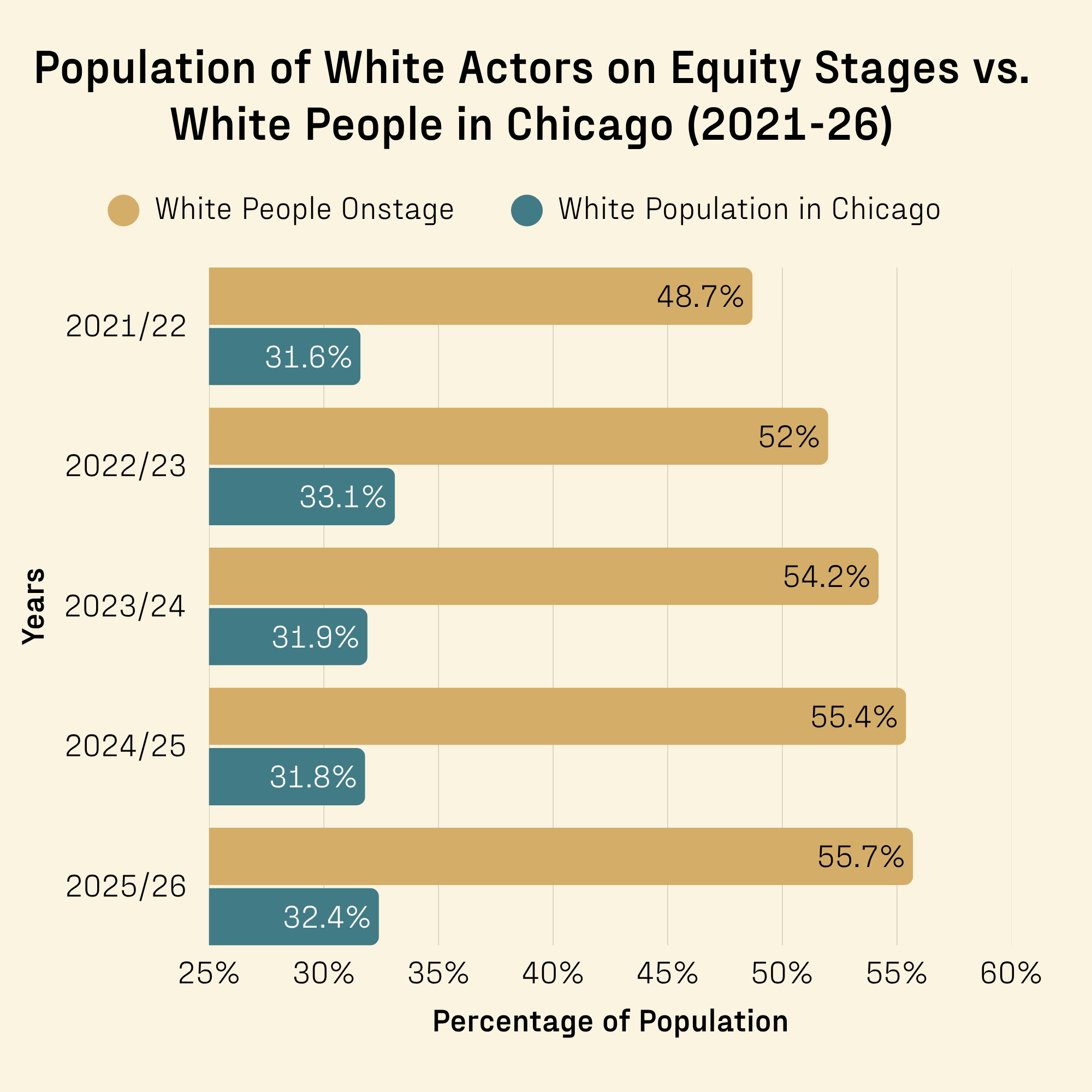
Chicago’s population is primarily split between white, black, and hispanic/latino populations, almost evenly. As you can see, a similar split is nonexistent on Chicago Equity stages. Of course, there is a bigger conversation to be had about access, segregation, and the pipeline from educational institutions to stages. But most glaringly, our stages get whiter while our population does not.
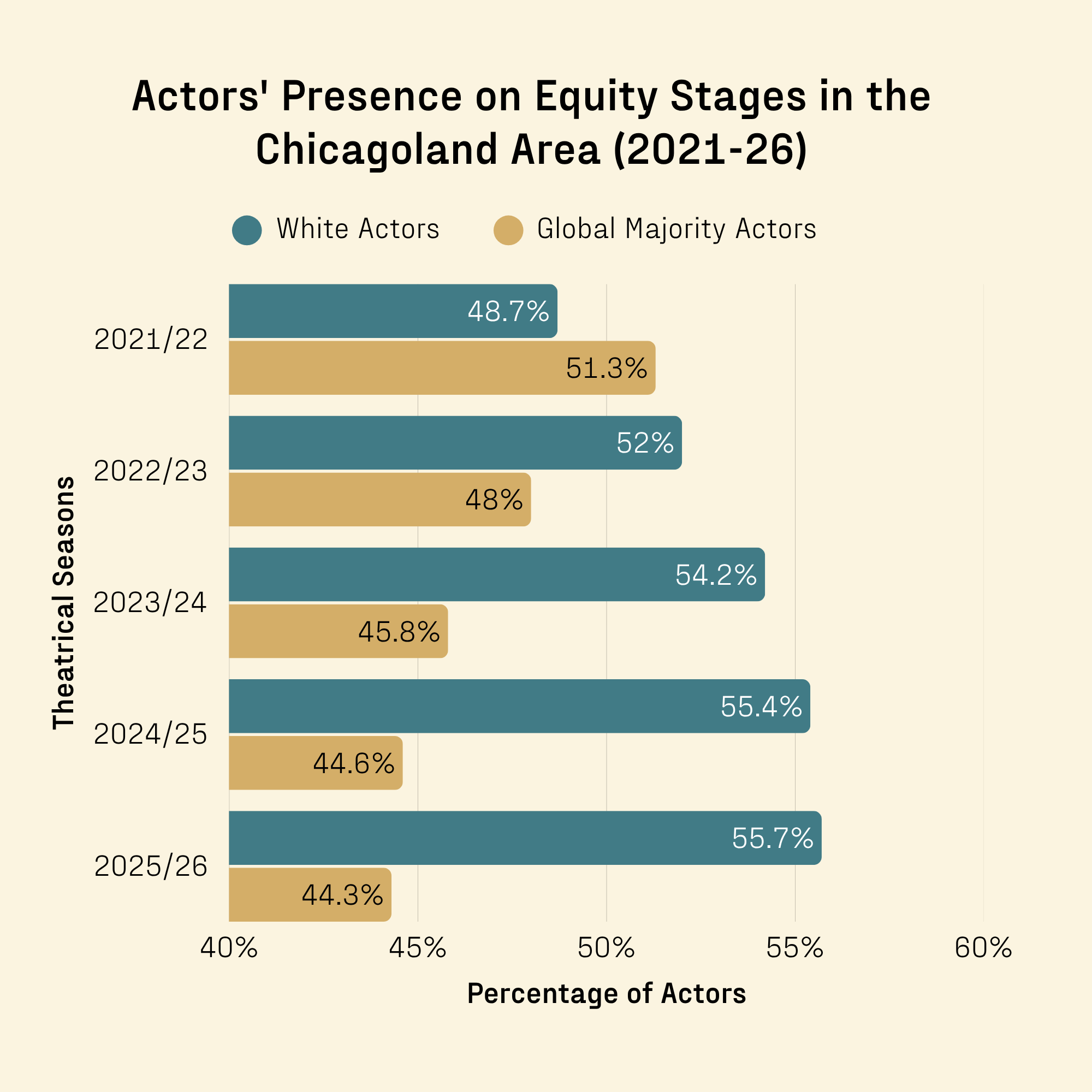
The farther we get from 2020, the whiter casts become. Plain and simple. Immediately post-2020, the actors in the Global Majority make up just over 51% — just over half — of the actors hired in the 2021-22 season. One race — white — makes up the other half. And that year is the best it gets.
In 2025/26, white actors were 23% more likely to be cast in an Equity production than in 2021/22. Meanwhile, actors in the global majority were 7% less likely to be cast. This is a huge jump — a 30-point gap — in just five seasons, especially considering that the 2021-22 season featured 745 actors, while the 2025-26 season cast 1,056 actors. Even with more total actors being cast, actors in the global majority are still less likely to make it onto an Equity stage.
This data isn’t meant to neglect all of the work at Equity theaters that may be happening behind closed doors. Instead, it’s meant to be a vehicle for measuring how fast change can happen (and if change is happening) on the surface. There is no role more front-facing than the actors on the stage, in the costumes, saying the words. The actors that school buses of school kids come to see, college students model their aspirations after, and designers spend hundreds of hours designing for.
So, if the majority of the people on Chicago area stages are white, this begs the question: Who is theater for? And who does it represent?
Subgroup Isolations
No Equity theater is quite like the other. They vary enormously in resources, geography, and national exposure. All aspects that inform their target audience and, subsequently, programming. Because of this, there’s no way to engage with this data without isolating some crucial sub-groups.
First, let's talk geography. A vast majority of Equity theaters are in Chicago proper, with only nine out of twenty-nine theaters located outside of the city. However, these nine theaters (see below) cast over 50% of the Equity season’s actors year over year, making a huge impact on hiring practices and employment for actors in the city and surrounding:
Writers Theatre
Northlight Theatre
Paramount Theatre
Marriott Theatre
Music Theater Works
Drury Lane Theatre
Oak Park Festival Theatre
Buffalo Theatre Ensemble
Artists' Ensemble Theater
Curious about where all these theaters are? Check out The Plotter’s Equity theater map.
Unsurprisingly, suburban stages are much whiter than Chicago stages. And while Chicago generally casts more diversely, the only year the demographic split comes close to resembling the actual demographics of the city is 2021-22. Every other season is whiter. For those counting, that’s the theatrical season immediately post-2020 Instagram DEI commitment posts.
It’s worth noting that the middle of the venn diagram between suburb-based theaters and theaters that exclusively (or, almost exclusively) do musicals is almost a circle. And while suburban theaters are famously not in the city proper, a majority of those theaters’ casts commute from within city limits. It’s also noteworthy that a straight play cast is typically between 2–10 actors — with a 5-actor cast being a recent favorite — the typical musical cast can span anywhere between 8–40+ actors.
Below are casting stats isolating the following musical-theater specific companies: Paramount Theatre, Marriott Theatre, Music Theater Works, and Porchlight Music Theatre.
Due to the inherent demands of producing a musical, these four theaters cast between 34-40% of actors in a given season, while their productions only represent 16-19% of the total Equity theater shows that season. While non-musical focused theaters walk either side of the 50% White line, musical-specialized theaters range from just over 57% white in 2021-22 to 65% White this current season (2025-26), and peaking in the 2024-25 season at a whopping 66% White.
The TLDR on that sprawling list of numbers is this: the Equity musical theater houses cast a disproportionate number of Chicago actors while casting overwhelmingly white casts that steadily increase in whiteness year over year. (Yes, even if they do Dream Girls.)
For our final sub-group, theaters have been separated by annual budget with the separating threshold being $2M, with an exact even split of theaters on either side (and Music Theater Works hopping below the $2M threshold for the 2022-23 season only).
Unsurprisingly, theaters with bigger budgets do more shows, cast more actors, pay more, have bigger audiences, and so on forever. Generally, we’re seeing the same trend repeated: seasons get increasingly whiter year after year. Something interesting, though, is that the higher-budget theaters tend to cast more actors in the global majority than their counterparts.
Initially, I found that shocking: theaters such as Goodman, Lookingglass, and Steppenwolf — whose subscriber bases are by-and-large older, whiter, and wealthier — are casting more diversity on their stages than younger, “grittier” Chicago companies whose financial stability isn’t necessarily as directly tied to their subscribers?
How is this possible? Perhaps it’s a matter of admin power — more employees following institutional promises through to the end. Perhaps it’s new leadership — all three of these major institutions have had new Artistic Directors step in during this five-year period. Perhaps it’s the level of platform — bigger theaters with bigger audiences holding them accountable to their promises. Impossible to know for sure, dealers' choice on what feels believable to you.
CONCLUSION
For years, each casting announcement that found its way onto my feed caused feelings. Feelings of doubt, confusion, and mistrust in the industry that promised to improve. Now, seeing the numbers — tangible, measurable, and real — I’m left feeling conflicted. It feels good to know that my instincts were right, that the casts did trend whiter every year across every kind of theater, no matter how I sliced it. It’s validating. But I’d rather be wrong than witness the whitewashing of our theaters year over year. Chicago theater is getting whiter. The City of Chicago isn’t.
I felt motivated to look at casting specifically because, at the end of the day, to be cast is to be hired. To be offered money for your work. Money that pays the bills, money to spend on seeing another play, money that places a value on craft (for better or for worse).
I’m not the first person to offer musings on racial casting in Chicago, not even by a mile. I hope this conversation inspires more conversation, inspires action. I hope, with the numbers right in front of us, we can actively work to make a change. To cast Chicago theater with the stories, experiences, and people of the Global Majority. Because, after all, it’s Chicago’s majority, too.
METHODOLOGY
For a full list of theaters, scope, and sourcing, check out the preface. Below is some methodology specific to this piece.
Chicago Census Source. Chicago Health Atlas counts hispanic/latino as a separate racial designation from other racial markers. This group has been counted within the Global Majority throughout the dataset.
Cast Lists. These were sourced from the internet. For some theaters, this means thorough production history pages directly on their website, and for others it meant instagram announcements, Broadway World articles, and other sources.
Actor Race. Recorded as white or global majority. This is not an exact science, and racial identity is nuanced and individual. Actors' identities are not disclosed publicly by theaters, agencies, or the like, and is not reliably inferable. Data was collected based on character descriptions, publicly available headshots, production-specific marketing, and general play demands. Any future version of this research that wants to do better on this dimension will need direct, voluntary disclosure from actors — which is a different kind of research project than this one. Race percentages in this analysis are over 500 productions and 4,957 roles cast.
The dataset is public. If you spot an error or omission, please send it and I will happily update the numbers accordingly. My priority is that this information is as correct as possible, and that this can be the start to a larger conversation.