


The Data
Behind the Drama
What five seasons of programming reveal about Chicagoland’s Equity stages — and who gets to write for them
By Connor Ermir Bradshaw
01 · THE PREMISE
The Art of the Season
A theatre season is a budget with opinions. Every title a company announces is a small argument about what deserves a stage, an audience, a run. Stacked across a city and over five years, those arguments add up to a portrait of what a theatre community believes it is for.
I spent a lot of time with that portrait. This piece is about programming: specifically, which plays got produced, whether they were new work or revivals, and who wrote them.
It’s one of two companion pieces drawn from the same dataset. Madie Doppelt’s casting analysis asks the parallel question one rung closer to the audience, not who wrote the words but who got hired to say them.
Read together they’re two angles on the same question: who is Chicago theatre actually for? The preface covers which theatres we counted, why we stopped at Equity houses, and how the data was assembled. I’ll point to it rather than repeat it.
The short version of the scope: 29 Equity theatres in and around Chicago, five seasons (2021/22 through 2025/26), 496 productions (once a handful of one-off benefits are set aside). For each one I logged two things. Was it a world premiere or a revival? And who wrote it? Everything below comes from those two columns.
02 · THE SHORT VERSION
Chicago Theater, by the Numbers
The findings, fast:
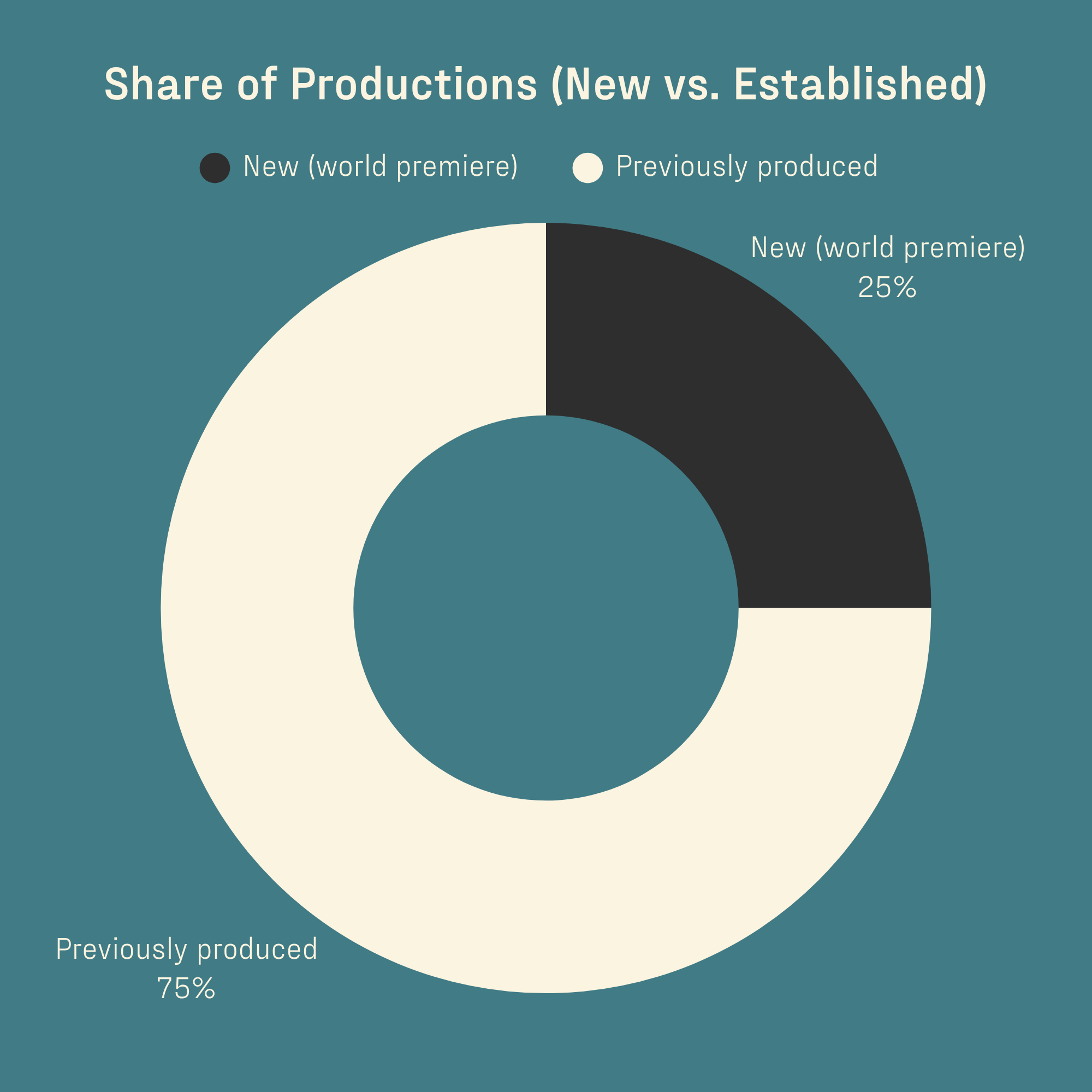
29 theatres, 5 seasons, ~500 productions. One in four was a world premiere. The other three-quarters had been produced somewhere before.
Overall authorship: 65% men, 30% women, 4% mixed collaborations, 1% trans or nonbinary playwrights.
But split by whether the work was new: world premieres ran 44% women. Previously-produced work ran 26% women, 70% men. New work is approaching parity. The inherited repertoire is not.
Form is a factor. Plays: 32% women-authored. Musicals: 17%, with men credited on 76%.
Season by season: We saw 31%, 38%, 30%, 36%, 18% women’s authorship across the the past five years (in chronological order, from 2021/22 to 2025/26).
The companies doing the most new work are also the most gender-balanced. They cluster in the city. The suburban musical houses lean heaviest on a male-authored back catalogue.
03 · NEW WORK, OLD CANON
Premieres vs. Proven Hits
Start with the (comparatively) rarest thing on a Chicago stage: a play nobody has seen before. Across five seasons, a quarter of all productions were world premieres. The dominant mode of Chicago’s Equity theatres is not invention but revival, staging work that has already proven somewhere else that it can fill a house.
World premieres held between 15 and 31 productions per season; previously produced work grew from 66 to 80.
To be clear, that’s not a scandal. At a time when arts funding is being slashed to ribbons and macroeconomic conditions are looking… let’s say “uninspiring,” it’s unsurprising that theatre companies are pushing for surer bets.
A previously produced play arrives with reviews, a known shape, an audience that may already love it, and a playwright with at least some influence. A world premiere is a bet placed with real money in front of people who have to renew their subscriptions (or reward the theatre with a return visit for another show). The wonder isn’t that theatres lean on proven titles. What is interesting is how completely the leaning varies from one company to the next.
Drury Lane, Paramount, and Music Theater Works, for instance, staged zero world premieres across the entire window. Porchlight, also none. These are big suburban musical operations, and their model runs on titles the audience already knows by heart. Then there’s the other end of the field: Rivendell premiered every single show it produced. Black Ensemble Theater, 94% of its work (the other 6% were revivals or productions of work it previously premiered). A Red Orchid, about 70%. New work is not spread evenly. It’s concentrated in specific kinds of theatres, usually smaller, mission-driven.
04 · WHO WROTE THE SEASON
Whose Pen, Whose Stage?
Who gets cast is Madie’s territory. This dataset is about who holds the pen. Whose plays get staged?
Tally up every Chicago production with a credited author and the headline is lopsided: roughly two playwrights in three were men. Thirty percent were women, four percent mixed writing teams, about one percent trans or nonbinary. In a vacuum, it looks like a familiar imbalance. One we’ve grown to know (and resent, to be clear).
But the single figure hides the most interesting thing in the data.
Split those same productions by whether the work was new and the field cleaves in two. Among world premieres, women wrote 44%, close enough to even that one could (charitably) call it a coin flip. I won’t, but others could.
Among previously produced work, women wrote 26%, men 70%. Same theatres, same artistic directors, same seasons. The difference is entirely whether the choice was about the future or about inheritance. The gender imbalance on Chicago’s stages is not being manufactured by what theatres commission today. Today’s commissions are nearly balanced. The imbalance is being inherited from decades of accumulated canon, carried forward one safe revival at a time.
Among world premieres, men and women wrote nearly equal numbers of productions. Among previously produced work, men outnumbered women nearly three to one.
When theatre companies opt for safer bets, they are also opting for male playwrights.
Nowhere is that inheritance heavier than in the musical. For context, plays were 32% women-authored. Not parity but definitely better than what you’re about to read.
Musicals were 17%, with men credited on more than three-quarters of the books and librettos.
The standard musical-theatre canon, the proven-title tier the commercial houses depend on, was built overwhelmingly by men. Leaning on it means importing that authorship wholesale. The suburban musical house isn’t (necessarily) making sexist choices show by show. It is, however, making canonical ones.
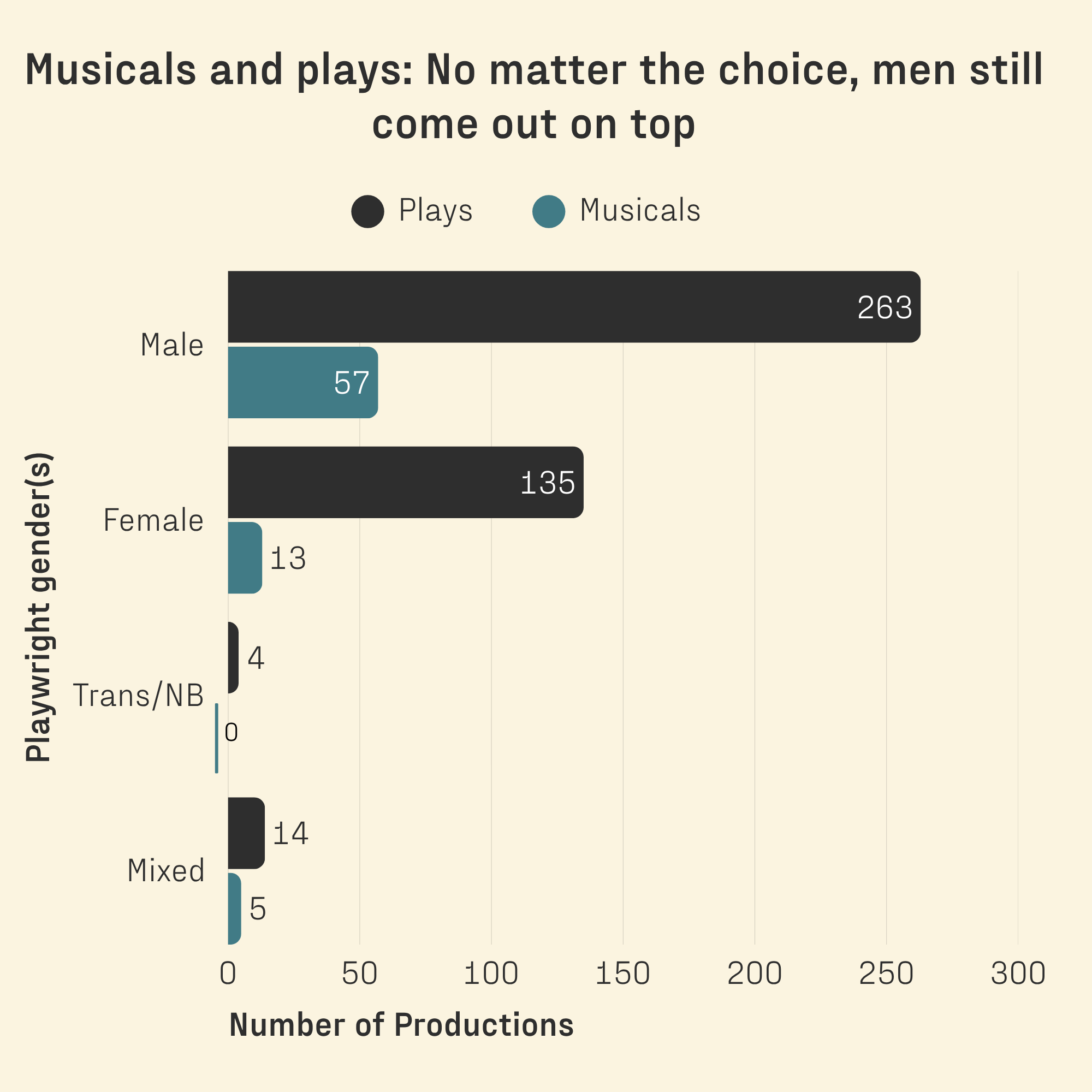
Male playwrights account for 63% of plays and 76% of musicals across the five-season window.
Has any of this authorship shifted over five years? Not in a clean line. Women’s share of all productions rose to 38% in 2022/23, slid back, climbed again to 36% in 2024/25, and then falls to 18% in 2025/26. That figure once again illustrates how precarious representation can be — even in the arts. When maleness is the default, a “safer” approach will beget further maleness.
Women's authorship share peaked at 37% in 2022/23 and fell to 18% in 2025/26 — the lowest figure in the dataset.
Plot each company by how much new work it does against how much of its writing comes from women and trans or nonbinary playwrights and the dots line up. Rivendell sits alone in the top-right corner: all new work, 88% women and nonbinary writers. The big commercial musical houses cluster at the bottom-left, little or no new work, few or no women. The balanced, premiere-heavy companies are overwhelmingly Chicago storefronts and mid-size North Side houses. The male-leaning ones reside in the suburbs.
Chicago's Equity theatres attributed 38% of productions to female playwrights. Suburban theatres: 17%.
The suburban, musical-driven houses that lean hardest on a male-authored canon are largely the same ones Madie’s data finds casting the whitest. The city houses programming the most new work cast closer to the city’s actual demographics.
Our two datasets keep pointing at the same places.
05 . CONTINUING THE CONVERSATION
What’s the Point?
If new work in Chicago is nearing gender parity, and the imbalance lives in the canon, then the future of who gets staged depends on something slow and unglamorous: which of today’s premieres get picked up, revived, produced again somewhere else, until they harden into the kind of title a theatre programs without having to explain itself. Today’s world premiere is tomorrow’s proven hit. But only if someone produces it twice, thrice, etc.
For context, Chicago is 51% female. According to the U.S. Census Bureau’s most recent American Community Survey estimates, women are the majority of this city — and have been for as long as anyone has counted. They buy the tickets. They fill the seats. They are, by any demographic measure, the primary audience for Chicago theatre. And across five seasons of Equity programming, 70% of the previously produced work they were invited to watch was written by men.
That gap doesn’t come from nowhere. It comes from a specific, defensible, and ultimately circular logic: risk-averse programming means reaching for proven titles, proven titles are the ones that have been produced before, and the plays that have been produced before are overwhelmingly by men — because the people making those decisions, for the last hundred years, were also overwhelmingly men. So the canon is male because it was built by men, and it stays male because building on it feels safe.
The frustrating thing is that the data also shows another path is possible. New work in Chicago is close to gender parity. The companies commissioning most aggressively — Rivendell, A Red Orchid, Black Ensemble, About Face — have figured out that a theatre’s mission and its programming can actually match. None of them are doing it by taking crazy risks. They’re doing it by deciding that the canon they’re building is the one happening right now, in their city, with the writers who are here. That’s a different definition of what’s safe.
To be direct about what this argument is and isn’t: a play written by a man is not, by virtue of that fact, a sexist play. Many searching, feminist-in-effect plays in the canon were written by men who understood something about power. The issue is the aggregate signal sent by a field that consistently reaches for male writers when it wants to feel safe — and what that signal tells every writer who isn’t male about whether the institution considers their work a risk worth taking.
One more thing the numbers can’t tell you. This dataset counts trans and nonbinary playwrights where writers publicly self-identify — fewer than 10 writers at a small handful of companies. That number is almost certainly wrong. Not because the research is sloppy, but because publicly available information about writers’ gender identities is incomplete by design: many trans and nonbinary people don’t disclose, and no public database tracks it. The census comparison is also a binary one — the ACS records male and female, not gender identity — which means the 51% female figure undercounts Chicago’s actual gender diversity in the same direction this dataset does.
The TGNC population of this city is real, present, and paying for tickets. It is essentially invisible in both the data we’re working from and in five seasons of Equity programming.
So…what’s the point I’m making? Today’s world premiere is tomorrow’s proven hit. But only if someone produces it twice, thrice, etc. The companies doing the most new work right now are building a different canon, one that might look a lot more like Chicago by the time it’s old enough to feel safe. Whether other institutions follow them there, or keep borrowing a past that was never built for this city, is the question the next five, 10, 15 seasons will answer.
Just click the text above to view the full findings. If you spot an error, an omission, a show I miscategorized, please send it. This is meant to be the beginning of a conversation.
06 . HOW I COUNTED
METHODOLOGY
The preface covers scope, sourcing, and the theatres included. Here’s what’s specific to this piece.
Productions vs. events. Five entries were held out as not-really-productions: one-night benefit talks by Eddie Izzard and Ian McKellen at Chicago Shakespeare, a Natalie Merchant concert and a toddler story-time series at Chicago Children’s, and a developmental workshop at Theater Wit.
Premiere status. Evidence-first: a show gets called “previously produced” only when a source explicitly confirms a prior production; “world premiere” only when documented as such. Ambiguous titles were individually verified. None remain undetermined in this cut.
Playwright gender. Recorded as male, female, trans/nonbinary, mixed (co-authored across categories), or devised/ensemble. Trans and nonbinary identity was assigned only where the writer publicly self-identifies — meaning it appears in a public bio, interview, or author statement. This likely produces an undercount. Gender identity is not reliably inferable from public sources, many TGNC writers do not disclose it in professional contexts, and no comprehensive database of playwright gender identities exists. Any future version of this research that wants to do better on this dimension will need direct, voluntary disclosure from writers — which is a different kind of research project than this one. Gender percentages in the analysis are over the 491 productions with a named, attributable author.
What to watch out for. A few source-data errors surfaced and were corrected in the dataset, including two plays credited to the wrong author in the original listings. The full dataset, with the basis for every classification, is linked from the preface; again, corrections are welcome and will be logged!