

A Review of Radical Futures at The Factory Theater
-
Radical Futures by B.Z. Florida; Dir. Kayla Menz
-
-
October 16-November 21, Fridays & Saturdays @ 7:30pm, Sundays @ 3pm
POINT
“How much is your life worth to you?”
“Everything.”
PLOT
In Radical Futures, we’re presented with a cavalcade of musings — hallucinogenic and sober — on what life has to hold (and what it’s withheld).
Set in a well-loved, oft-empty, worn-out bar (adorned thoughtfully with posters, bottles, and remnants of the past by props designer Randy Rozler), playwright B.Z. Florida’s new play focuses squarely on the concept of a life well lived. What’s the right career? How can you extract the most out of life? What elements will you “ship of Theseus” yourself out of in the name of optimization? And how much of this pursuit masks a more obvious problem: that you’re neglecting your emotional state?
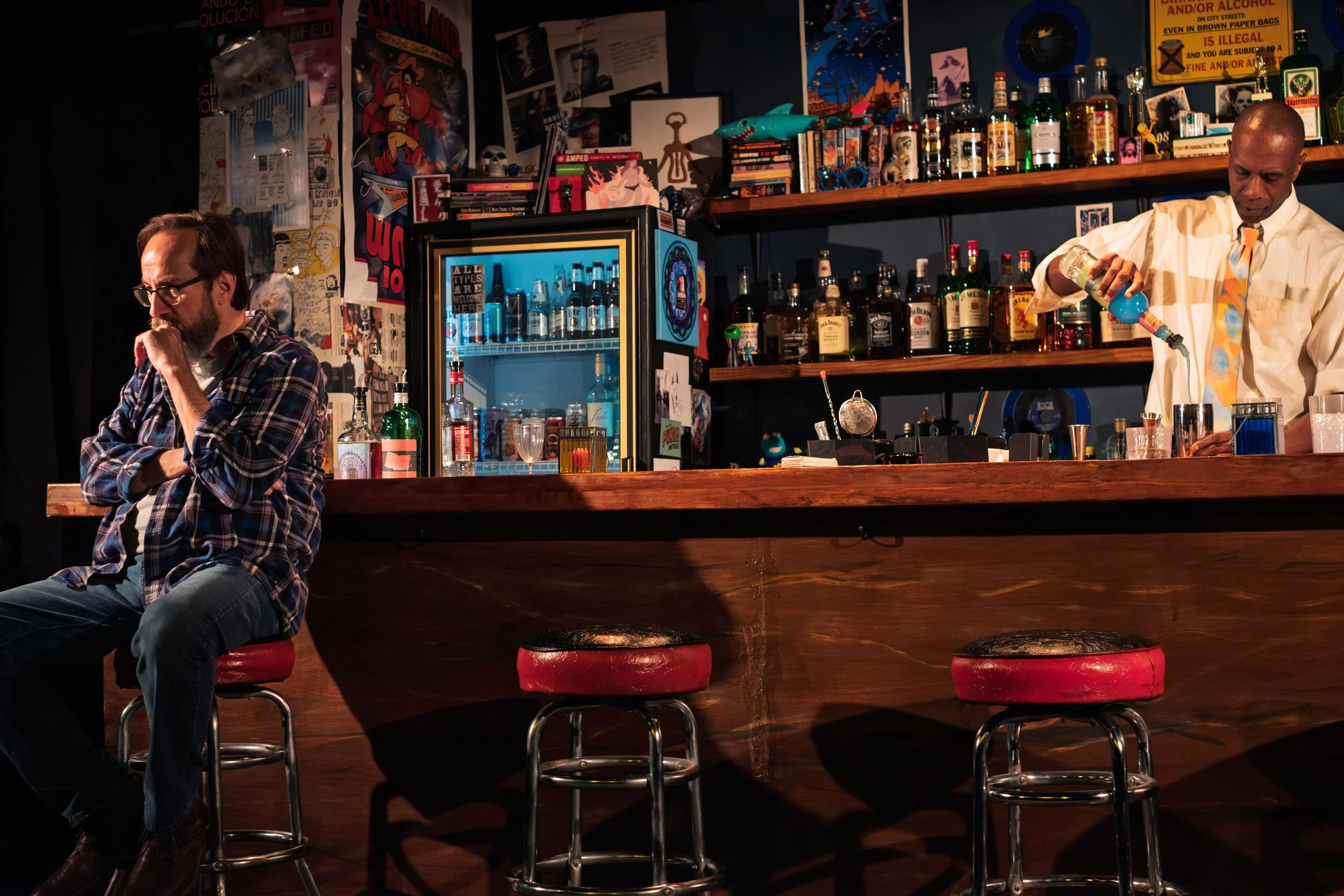
Neal (Eric Frederickson) seated as Warren (Bradford Stevens) pours him a cocktail.
Bar owner Neal (Eric Frederickson, convincingly beleaguered) hasn’t seen his former business partner and friend Warren (Bradford Stevens) since buying out his portion of the bar years ago. Tonight, Warren, a venture capitalist fresh from New York, has returned with a proposition: to buy back his half of the bar and run it with his former business partner.
Exposited over tableaus (conjured via hallucinogenic cocktails, aptly named after popular dystopian tales and authors), the two attempt to reconcile their fears and divisions. Why did Warren leave, and what did leaving grant him? Why has he come back? And what does Neal need from him — now, and before?
Each tableau takes place in the foreground, as the two friends bear witness to the unfolding scene in the background. Tableaus range wildly.
One concerns a haughty career counselor (depicted in all her heightened vexation by understudy Christine Watt) and spritely student (played with a bemused charm by understudy AJ Noon) looking for the right path.
Another involves an estranged father (Matt Chester) and daughter (Annie Beaubien), who works at Mournful Entertainment, a fictionalized Disneyworld analog; the two attempt to patch things up and forge closeness amid a late-stage capitalistic hellscape.
Actors across these tableaus are triple- and sometimes quadruple-cast, with distinct costumes (courtesy of designer Valerie Cambron). In one tableau, an actor is a disgruntled assassin (the one who poses this review’s epigraph / Point, then prices a victim’s life at her rent: “Your rent or your life.”). In the next, they’re a robot. This, on the one hand, gives actors ample room to highlight their range. (Beaubien, in particular, is a standout in this regard.) On the other hand, this makes it difficult for performers to settle into their roles. Narrative arcs are eschewed in favor of evocation.
In a similar vein, this casting, depending on your charitability, either enhances or muddies the hallucinogenic effects of the play writ large. “Who am I supposed to track?” you may think to yourself, before a new scene with the same actors unfolds.
More pointedly, Florida’s new play is far more interested in the feeling of the thing than the accurate rendering of it. At-times dizzying pacing means compromising on exposition. And when the point of the play — seemingly — is to elucidate the fear of an uncertain future, it’s perhaps no surprise the character study element of playwriting takes a backseat.
Warren mentions a voicemail in the first minutes, and Neal denies leaving it for most of the evening. By the time we learn what it said (enough to frighten Warren back home), and what Neal has been carrying (a daughter who died of an overdose, for one), it’s difficult to feel the significance of these revelations. They’re striking. But they land awkwardly.
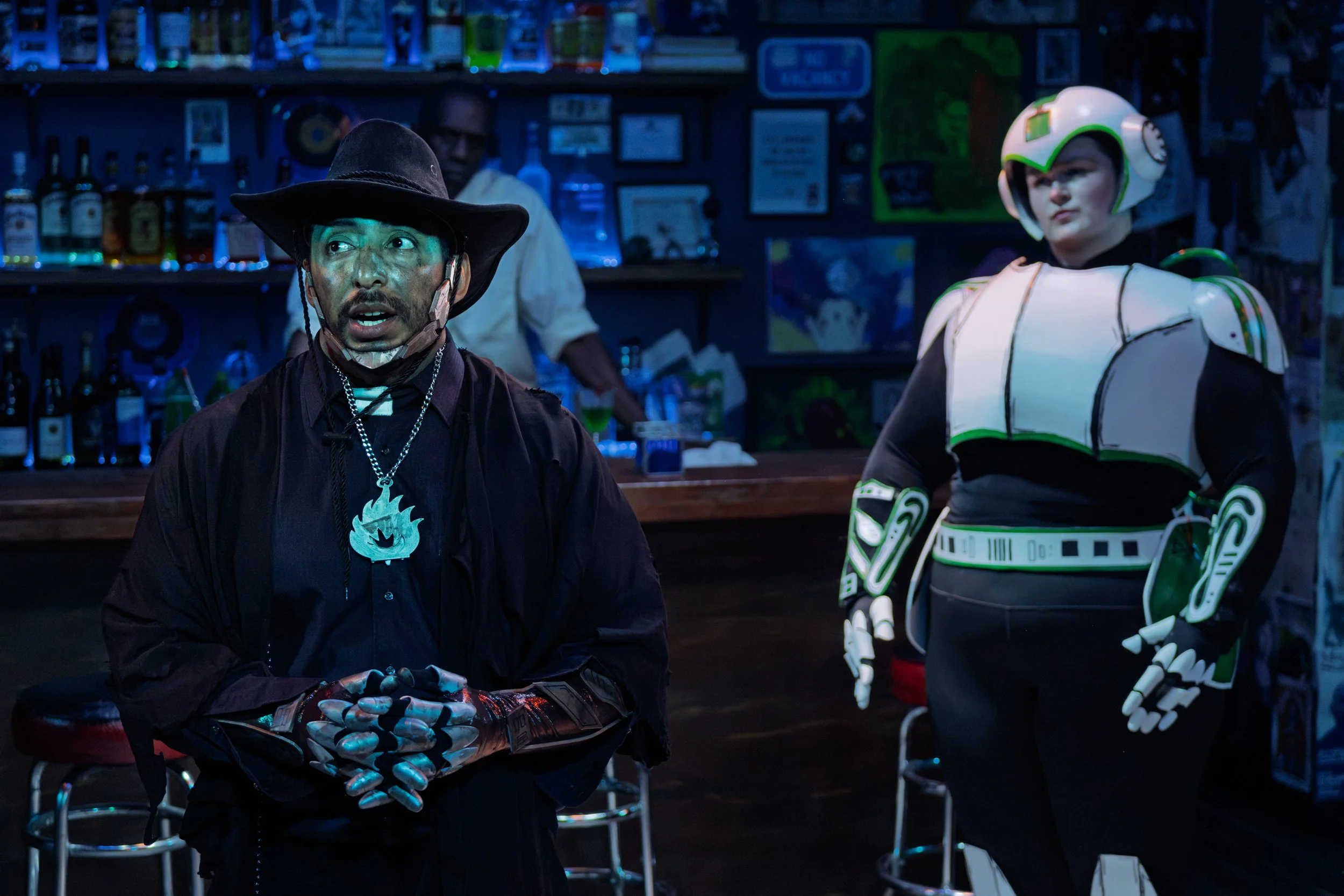
Robot Priest (Matt Chester) waxes poetic with Dorothy (Annie Beaubien).
The logic of the tableaus arrives just as late. Near the end, Neal turns on Warren, calling him the Robot Priest, a man who “replaced everything you had until you no longer felt alive.” It’s a click, the moment the visions reveal themselves as mirrors of these two men, but it comes so far into the evening that “Who am I supposed to track?” question goes unanswered for most of it. Should we invest ourselves in these characters? Or focus on sinking into the dread they experience?
Radical Futures is lofty in its scope and vision. The Factory Theater is willing to buck theatrical norm and convention in the name of pursuing a distinct, for lack of a better word, “vibe.” Mileage varies on its effect, but it’s unquestionable that the celebrated storefront has made this a staple of late.
My performance was nearly sold out, with audience members clapping enthusiastically after every tableau, as if each were its own musical number. That says something about the play’s construction: a revue of vignettes, each built to land on its own. There is clearly a demand for this sort of experience, a phantasmagoric, fever dream’d indictment of capitalism’s impact on growth and how we value our time on this planet.
Overall, it felt very fringe: ambitious, rough around the edges, and earnest.
But what can we take away from this?
LEAP
New plays are risks. New plays from unproduced playwrights are even bigger risks.
Commercially, who’s to say what kind of success Radical Futures will turn out to be? A full house on a Halloween weekend should bode well. But the play’s subject matter, its lack of convention, are, too, risks.
As we think about how much our life is worth, I think of how much our — and, really, my — time is worth. A 50-minute CTA trip there. A 30-minute Lyft back. A 90-minute production that’s content with idling, then hitting the gas, then idling again.
So much of storefront theatre is done in the name of love. The hours you work are many. The pay is meager. The critical acclaim is rarely offered. And yet, we do it anyway. Over and over again.
I didn’t leave this play with a new insight that I could repurpose into, say, a LinkedIn post. I spent $34 on Lyfts and CTA fare. Capitalistically, this experience represented a loss.
But I was happy to make it. I chatted briefly with the playwright, buzzed about the design and concept with my fellow patron(s), and went home excited to write about the production.
What’s quantifiable about that? Who’s to say, definitively, how much my time was worth and the extent to which this play was commensurate?
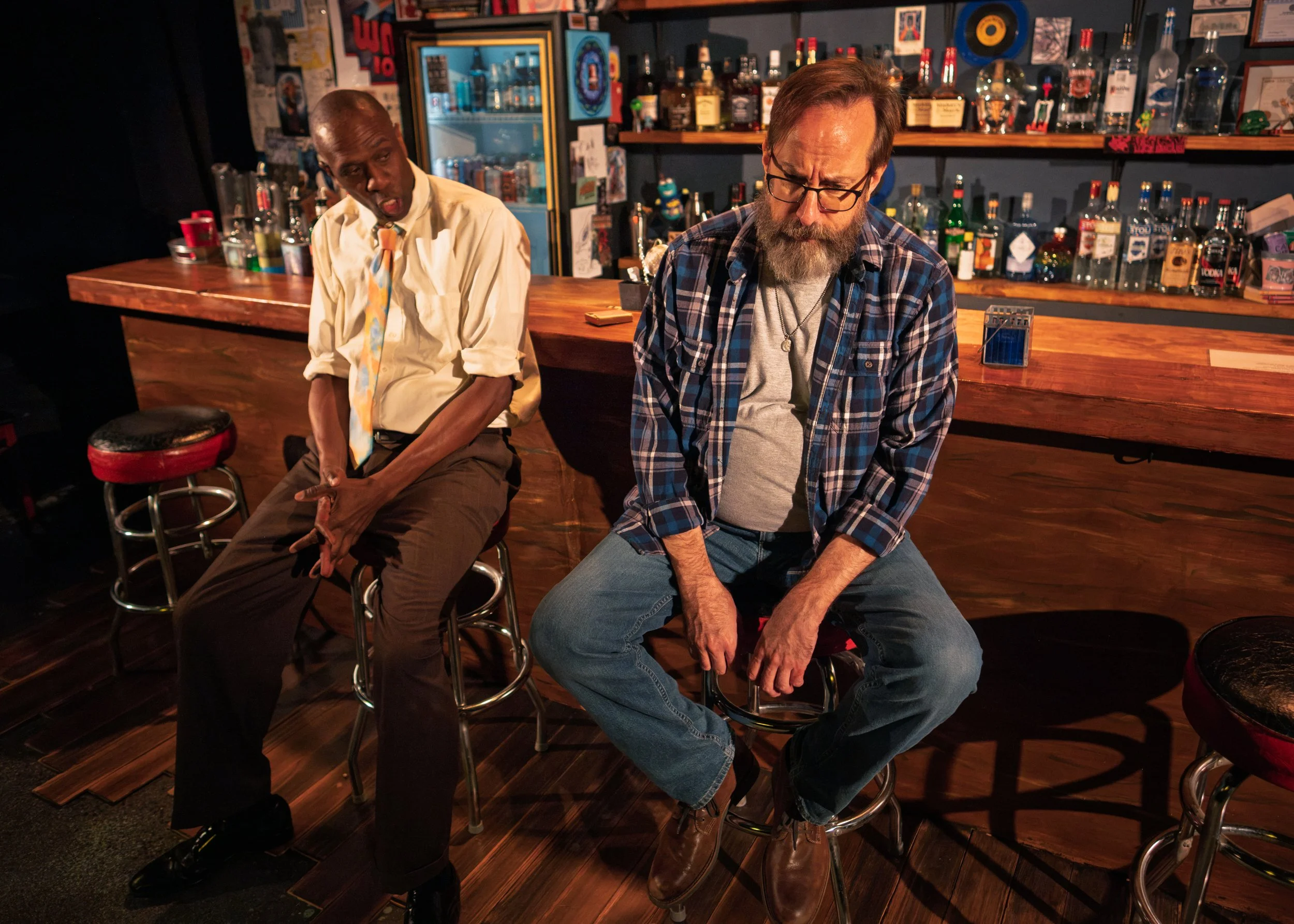
The play, to its credit, lands somewhere similar. After an evening of dystopian cocktails, its last gesture is to put them down. Warren says he isn’t ready for another of “those drinks”; Neal reaches for the sixth bottle on the shelf, the wine that has been there since the top of the show. “That is what the wine is for.” The two men toast “the future.” It’s a small, unforced image, and it’s arguably the play’s best answer to its own question: that a life isn’t priced by optimization, but by who’s in the room.
