

A Review of Red Theater’s Church Hurt
-
Church Hurt by Brynne Frauenhoffer; Dir. Jessica Love
-
-
October 24 – November 21
POINT
A tapestry that falls over a wooden cross, mounted above the audience.
PLOT
Church Hurt begins with a cross. As audience members find their seats, it sits above on an otherwise barren set and waits for the show to begin. When the show starts, Faith (played with an imploring earnestness by Alice Wu) kneels in front of it, the cross lit from behind with a glaring fluorescent glow, and looks up above the audience to pray for guidance. No one answers her.
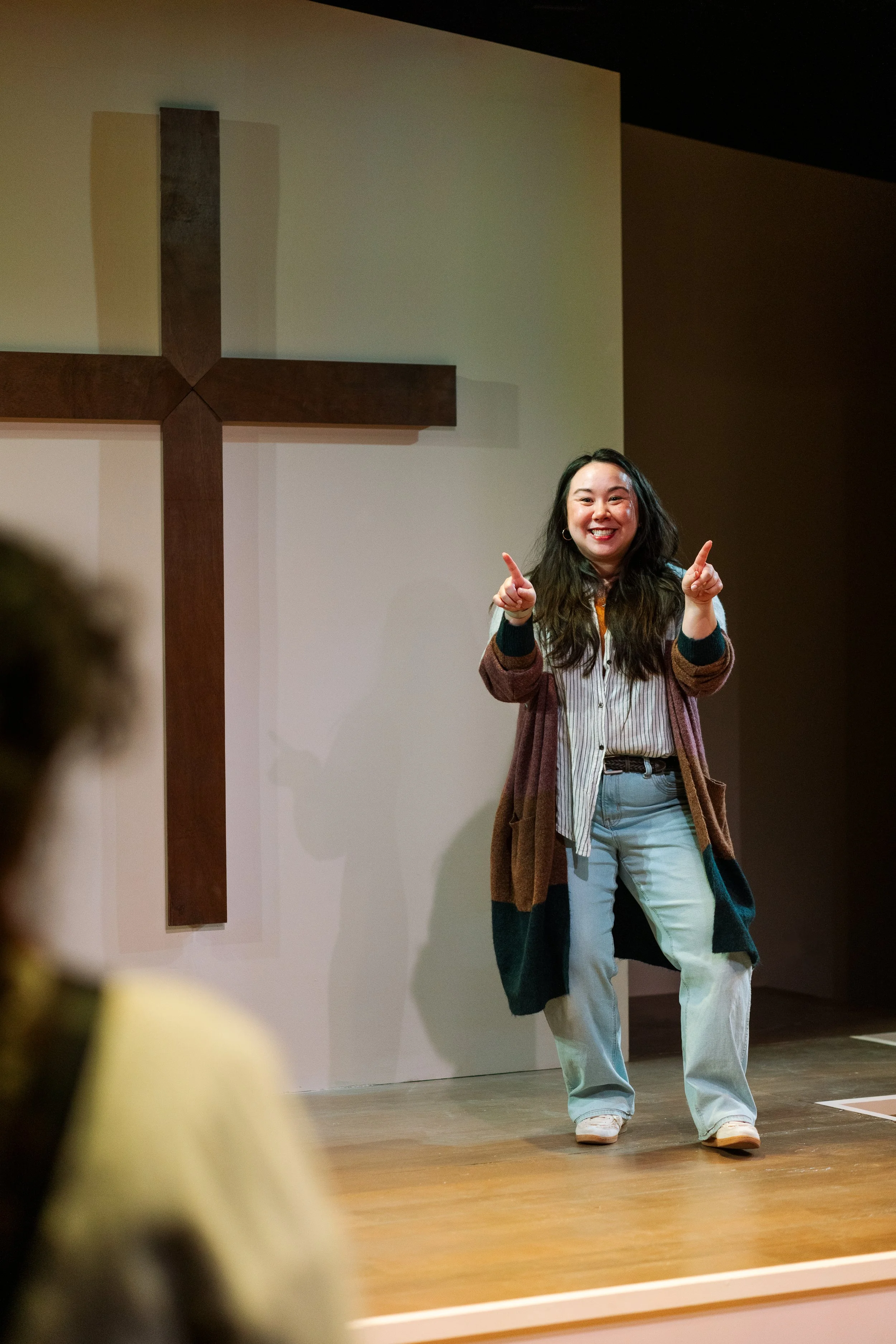
Alice Wu as Faith, standing near the aforementioned cross
The show is a dance between Mar (played with subtlety by Sara Sadjadi), Faith, and Julie (a youth leader bursting with sincerity, played by Laura Michele Erie), three friends from the same youth group. Mar has come back to the church after seven years of silence, Faith never left, and Julie has likewise stayed because she means to change the place from the inside. The conversation of the piece centers around queerness and faith. It questions whether institutional dogma is flexible, or if flexibility is the responsibility of the people who make up the institution.
Playwright Brynne Frauenhoffer sets that question inside a thriving non-denominational church (named Summit…kinda like Hillsong, huh?) in Missouri and gives each woman her own answer to it. Mar, a lapsed member of the church and a lesbian, returns to work there and hides both from nearly everyone behind a testimony of addiction and repentance she no longer believes (or, rather, never believed). Julie, a proud bisexual, remains strong in her faith. Faith wholly aligns herself with the church’s dogma and struggles to accept her friends, because their identities contradict beliefs she holds sincerely and is afraid to question.
As the show progresses, the cross stays put while the scenes around it swing from reunion to reckoning. At first, its purpose may be as simple as a reminder of location. “Don’t forget, we’re in a church!” When the tapestry briefly falls in front of it, its presence transforms.
When the tapestry lands, we find ourselves sitting with Julie and Mar alone. It’s casual, it’s unguarded, it’s “girl time.” A sigh of relief passes through the theatre, and, for once, it all seems okay. Under the tapestry’s cover, there seems to be no one watching. Mar and Julie laugh about WLW stereotypes, trade dating-app horror stories, and swap memories of celibacy culture, and something about the cross becoming invisible makes everything feel...normal. Almost everywhere else Mar is delivering a testimony, but here she can finally say out loud that she’s a lesbian who has lost her faith and told the church the story it expected to hear.
As the scene ends and we transition into the next, Faith enters and rips the tapestry down. There emerges the cross, and the show barrels on. The production never remarks on the fact that Faith is the one who does it, so visually she becomes the cross’s enforcer.
With the tapestry gone, the cross goes back to being a watchful eye that never says a word. For Mar, it reads as an all-knowing, ever-present spy that compels adherence to the “guidelines” of the church. Julie once again complicates that reading. She believes the church can change and is still serving in it, until the church asks her to step back from the worship band, Bible study, and Baptism Sunday over a song she texted a teenager. The watching she never felt turns out to have been there all along.
Throughout the play, we see this trio of women operate in various proximities to the cross and to Christian dogma. Director Jessica Love literally places them closer to, and further from, the cross to great effect, further emphasizing this distance and closeness. Amid this activity and movement, stillness and flurry, the question I kept returning to was: What makes up a community?
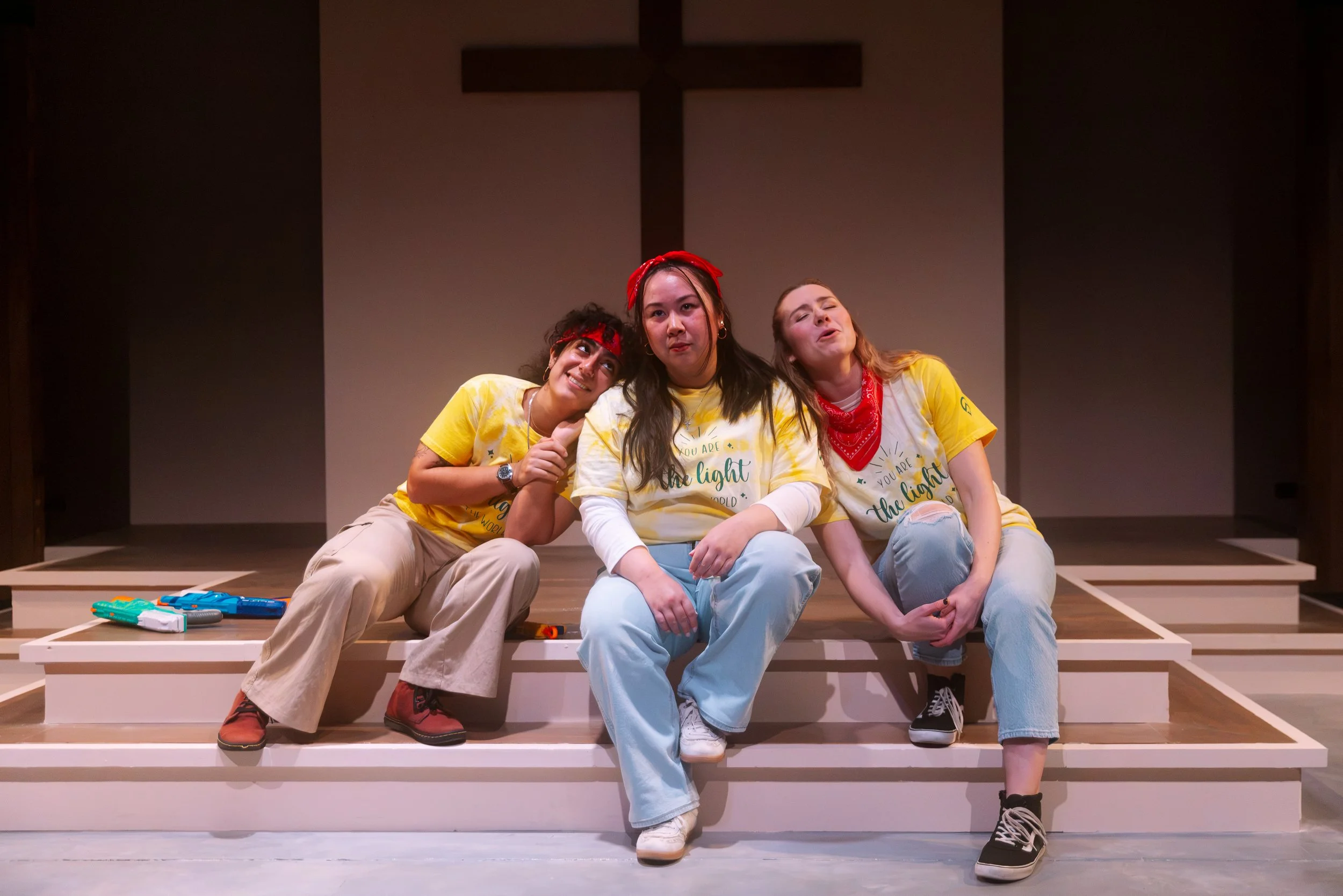
Sara Sadjadi as Mar, Alice Wu as Faith, Laura Michele Erle as Julie
LEAP
Some reject their church, some want to enact change within it, and some even reject their queerness in alignment with it. Church Hurt puts one of each on the same stage, and the scene where the tapestry covers the cross is, interestingly, where I felt community the most.
Two young women chatted about so many things I know as a queer woman myself, and I laughed aloud, snickered, and sighed. I was a spectator in a dark room, watching two actors perform a scripted version of intimacy, but a room full of people agreeing to look at the same thing is its own kind of congregation.
Julie’s whole position, though, is that belonging can live inside the church. Does the show suggest community only exists when the institution’s symbol is hidden? I don’t think so, but her belonging holds up only until the institution has to look straight at it. That begs the question of whether “community” is a location, shared beliefs, shared history, mutual goals, or E) all of the above.
The cross began as a Roman method of execution, used on enslaved people, political dissidents, and noncitizens as well as those convicted of crimes. To Christians, Julie included, it is also a symbol of sacrifice and redemption. I’d argue the production asks us to hold both realities: Faith kneels to the cross as a source of rescue while Mar relaxes only once it is covered. If an institution’s symbol, the one meant to unify a body of individuals, is both torture and salvation, what does that mean for those within it?
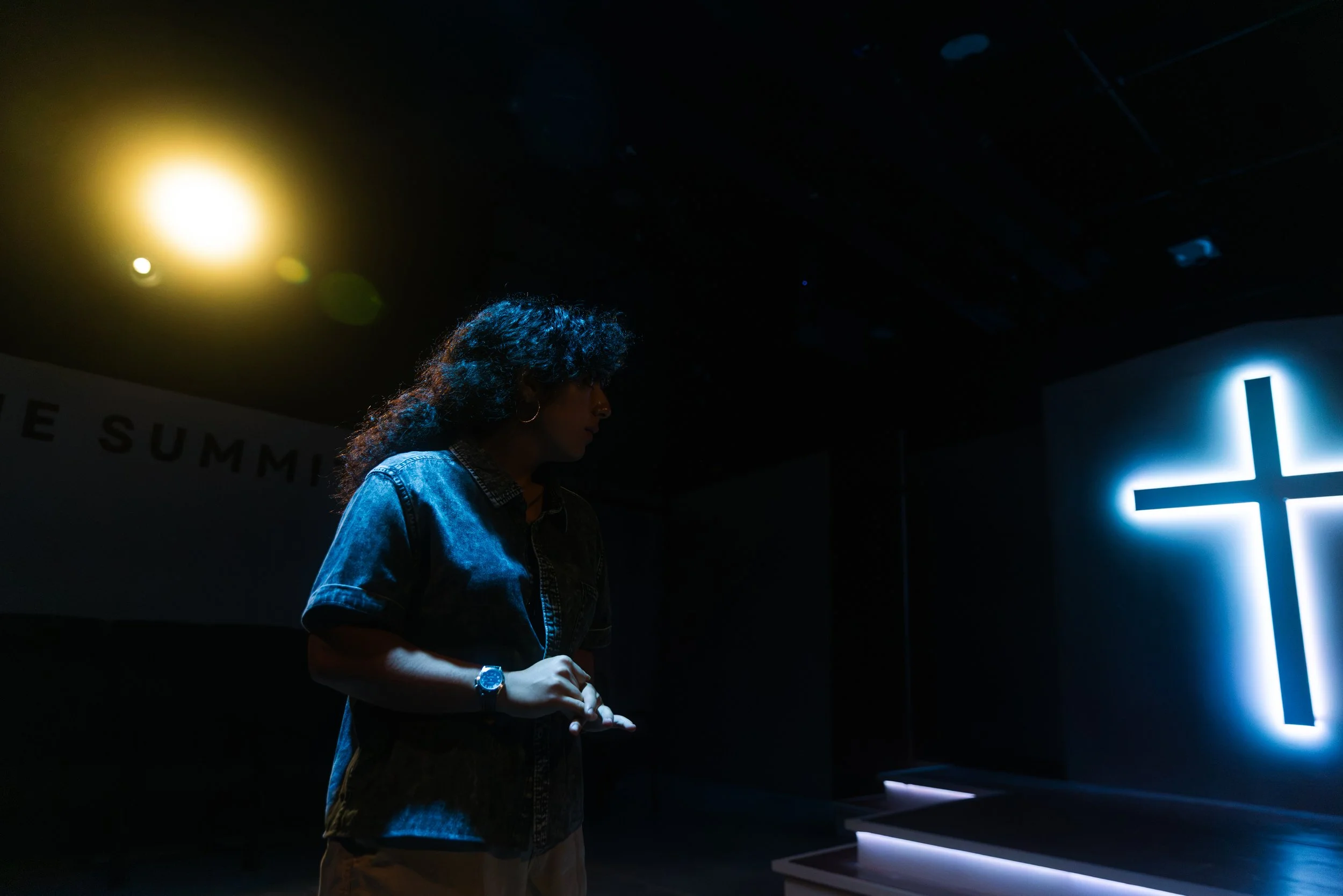
Sara Sadjadi as Mar
And what of the community built in rejection of the cross? As a proud member of the queer community, I will respectfully call us out in saying that we are not immune to causing harm within it. Set the two communities side by side in Mar’s life and the resemblance is…uncomfortable.
Both speak in love. The church says it loves her and seemingly proves it by giving her a job and a community; and Julie loves her so openly that seven years of silence and distance left her asking what she did wrong.
Both offer Mar a home. The church gives her a place on staff, and Julie gives her the first room where she can say out loud that she is a lesbian.
Both also want something in return. The church demands a testimony, a “coming out” of a certain sort: addiction, repentance, a woman redeemed. Mar offers them what they wanted, though it isn’t authentic. Julie wants a coming out too. She tells Mar that hiding in this way gives the church power over her story — and over others who may be like her in the future. Each community believes it is protecting something, souls in one case and progress in the other, and each asks Mar to serve as the proof.
What they don’t share is power. The church can fire Mar. It can remove Julie from the worship band, Bible study, and Baptism Sunday over a song she texted a teenager. Julie has no job to take away. She never outs Mar, she asks forgiveness the first time she pushes too hard, and the two keep talking. When the church disagrees with someone, it asks them to step back. When we disagree, by contrast, we lean in.
Maybe the difference between the two communities, then, is negotiation. Expectations don’t have to mandate action. Julie wants Mar to disclose her truth, but that desire isn’t leveraged against a job, against the stability a job offers. And Julie doesn’t threaten to expose Mar, using the institutional power she holds to compel action. She engages deeper.
Now look at the the church. It loves Mar, but it does so under the condition that Mar acts piously and serves as an example of what a “good” lesbian might do: maintain celibacy and avoid calling attention to her queerness.
Both communities offer support, but only one offers it unconditionally. Both communities expect a testimony, but only one is supportive of the unvarnished truth.